Best Grants & Support Schemes for Singapore SMEs in 2026

Singapore SMEs have access to a wide range of government grants, financing schemes, tax incentives and workforce support. The challenge is rarely finding a programme that exists. It is knowing which one fits the business need, what the funding actually covers, and when an application needs to be made.
This article discusses the funding support most relevant to a Singapore SME today: the government grants, loans, and financing schemes available, in plain terms. Each grant below covers what it includes, who qualifies, how to apply, and how much support is available, stated in both percentage terms and the applicable dollar cap.
Note: Singapore is moving toward a new consolidated EDGE grant, which will bring EDG, PSG and MRA together under one scheme. Existing schemes remain relevant during the transition, while other programmes have been introduced or enhanced for workforce transformation, sustainability and business resilience.
Enterprise Singapore has confirmed that EDGE will launch in the second half of 2026, but detailed operating terms have not yet been published.
Which Singapore SME grants and financing schemes are worth exploring in 2026?
1. Enterprise Development Grant (EDG)
Most relevant for: Business transformation, automation, new product development, process redesign, capability building and overseas expansion.
What is the Enterprise Development Grant?
The Enterprise Development Grant (EDG) supports projects that help a business improve how it operates, develop new capabilities, or expand into overseas markets. It is a project-based grant, so the company needs a defined business improvement or growth project.
It is broader than a grant tied to one particular software product or piece of equipment, making it one of the more flexible schemes for SMEs undertaking structured transformation.
What does EDG cover?
EDG funds qualifying project costs such as:
third-party consultancy fees
software and equipment
internal manpower costs tied to the approved project
The project needs to have a defined business objective and outcome. Projects fall under three categories:
Core Capabilities (business strategy, financial management, human capital, service excellence, brand and marketing)
Innovation and Productivity (automation, process redesign, product development)
Market Access (entering new overseas markets, adopting international standards)
Who qualifies for EDG?
The company must:
be registered and operating in Singapore
have at least 30% local shareholding held directly or indirectly by Singapore Citizens and/or Permanent Residents
be financially ready to start and complete the project
Enterprise Singapore assesses applications based on factors including project scope, project outcomes and the competency of the service provider.
How much does EDG support?
Local SMEs can receive up to 70% of eligible project costs. There is no universal fixed dollar cap for EDG. The grant amount is determined against the approved eligible project cost.
Can EDG be used more than once?
Yes. A company can apply for EDG support for different qualifying projects. There is no stated annual application limit or universal annual funding cap for EDG itself. Each project is assessed and approved separately by Enterprise Singapore.
This may change under EDGE. The government has announced that EDGE will provide up to S$100,000 per year for eligible activities, with additional support possible on a case-by-case basis. Full details and rules for EDGE are yet to be announced as of this writing.
How do companies apply for EDG?
Applications are submitted through the Business Grants Portal (BGP) using CorpPass.
The application should be submitted before the project starts and should set out the project scope, activities, costs and expected outcomes.
How does EDGE change EDG?
Enterprise Singapore has confirmed that EDGE will launch in the second half of 2026 and consolidate EDG, PSG and MRA into one scheme. Existing EDG applications remain available until EDGE launches. Enterprise Singapore has not yet published the full details on EDGE support rates, caps or application mechanics, so those details should not be inferred from the current EDG rules.
2. Productivity Solutions Grant (PSG)
Most relevant for: Adopting pre-approved software, IT solutions and equipment to improve day-to-day productivity.
What is PSG?
The Productivity Solutions Grant (PSG) helps businesses adopt specific, pre-approved IT solutions, equipment and productivity tools. It is suited to businesses that already have a clear need and can use one of the solutions covered by the scheme.
Unlike EDG, PSG works from a curated list of supported solutions and vendors. This makes the route more straightforward for businesses with a clearly defined technology need, but it also means that not every software product or technology purchase qualifies.
What does PSG cover?
Supported solutions cover areas such as:
accounting
inventory management
customer relationship management
e-commerce
selected cybersecurity and other digital solutions
sector-specific productivity solutions and equipment
The full list of pre-approved PSG solutions can be found here.
Who qualifies for PSG?
A business generally needs to:
be registered and operating in Singapore
have at least 30% local shareholding
meet the applicable SME definition
use the supported solution or equipment in Singapore operations
The particular solution must also be on the applicable pre-approved list.
Eligible SMEs are also linked to pre-approved digital solutions under PSG through IMDA's SMEs Go Digital programme.
How much does PSG support?
Local SMEs can receive up to 50% of eligible costs, subject to a S$30,000 company-level cap under the current scheme.
The cap and support rate apply according to the relevant PSG solution and scheme rules.
Can PSG be used more than once?
PSG does not function like a one-time S$30,000 voucher that must be spent on one purchase. Companies can make multiple qualifying applications subject to the applicable company-level cap and the rules of the supported solution.
Because PSG is being consolidated into EDGE in 2026, the current rules should not be assumed to continue after EDGE launches.
How do companies apply for PSG?
The company should:
Identify an eligible pre-approved solution and vendor.
Obtain the relevant quotation.
Submit the application through BGP.
Wait for approval before making the commitment.
Implement the solution.
Submit the claim and supporting documents.
A key condition is that the applicant must not have paid a deposit or made payment to the vendor before applying.
How does EDGE change PSG?
PSG is one of the three schemes that Enterprise Singapore has confirmed will be consolidated into EDGE in the second half of 2026.
Until then, SMEs can continue applying for PSG under the current framework. Enterprise Singapore has not yet published the detailed EDGE mechanics, so the current PSG S$30,000 cap should not be presented as an EDGE entitlement.
3. Market Readiness Assistance (MRA) Grant
Most relevant for: Entering a new overseas market and funding the practical work required to establish a presence there.
What is the MRA Grant?
The Market Readiness Assistance Grant (MRA) helps Singapore companies enter new overseas markets. It covers selected costs for overseas promotion, business development and setting up in a new market.
What does MRA cover?
MRA has three funding pillars:
Overseas market promotion
Overseas business development
Overseas market set-up
The scheme can therefore support activities such as overseas marketing and promotion, identifying or developing overseas business opportunities, and certain market-entry costs.
Who qualifies for MRA?
The company must generally:
be registered and operating in Singapore
have at least 30% local shareholding
meet the applicable SME criteria
be new to the target market under the current MRA rules
For the current new-market requirement, annual sales in that target market must not have exceeded S$100,000 in any of the preceding three years.
How much does MRA support?
Since 1 April 2026, MRA provides enhanced support levels of up to 70% support for eligible costs for local SMEs.
The grant is capped at S$100,000 per company per new market, with the cap divided across the three pillars:
up to S$20,000 for market promotion
up to S$50,000 for business development
up to S$30,000 for market set-up
The enhanced 70% support runs until 31 March 2029.
Can MRA be used more than once?
Yes, but the current scheme is structured around the target market and the applicable pillar caps.
A company can make multiple applications for qualifying activities in a market until the relevant funding limits have been reached. Once the applicable company-per-market and pillar limits have been exhausted, the current MRA framework does not provide another allocation for that same market.
How do companies apply for MRA?
The company identifies the target market and activity, obtains the required proposal or quotation, and submits the application through BGP before the project starts.
How does EDGE change MRA?
This is one of the more significant announced changes. The MRA updates announced in 2026 reflect the Singapore government’s increased focus on supporting overseas market expansion.
Enterprise Singapore has confirmed that, when EDGE is implemented in the second half of 2026, support will be expanded beyond entering new markets to include deepening activities in existing overseas markets. Eligibility will also be extended to local non-SMEs, with support of up to 50% for eligible costs.
Note: The detailed EDGE operating rules have not yet been published.
4. NTUC Company Training Committee (CTC) Grant
Most relevant for: Companies undertaking business and workforce transformation together, particularly where transformation involves productivity, job redesign and employee capability building.
What is the CTC Grant?
The NTUC Company Training Committee Grant supports entities that have formed Company Training Committees (CTCs) to implement transformation projects that lead to better worker and business outcomes.
The grant is managed by the National Trades Union Congress’ (NTUC) Employment and Employability Institute (e2i).
What does the CTC Grant cover?
Projects can address areas such as:
business process transformation
productivity improvement
job redesign
workforce skills development
technology adoption linked to business and worker outcomes
The key distinction is that the training or transformation activity needs to form part of a broader transformation project rather than being treated simply as standalone staff training.
Who qualifies?
Singapore-registered or incorporated entities can apply, including companies and certain non-profit organisations.
The applicant must have a CTC and the project must demonstrate how it will lead to better worker and business outcomes. Government bodies, statutory boards, organs of state and wholly owned subsidiaries are excluded.
How much does the CTC Grant support?
The CTC Grant provides up to 70% of qualifying costs for each project. The official current programme page does not state a universal company-level dollar cap.
Can the CTC Grant be used more than once?
The grant is project-based. Companies can apply with projects rather than treating the grant as a one-time company credit. The applicable funding and approval remain subject to the project's assessment.
How do companies apply?
The general process is:
Form a Company Training Committee.
Develop a transformation project showing the expected business and worker outcomes.
Obtain CTC endorsement.
Submit the endorsed project through NTUC e2i's grant process.
Companies are encouraged to engage e2i during project development.
What makes CTC different from workforce training grants?
The CTC Grant is particularly useful when business transformation and workforce transformation are part of the same project.
A company simply looking to send employees to a course may have other SkillsFuture or workforce support options. A company redesigning jobs, introducing technology and building the skills required to use it has a stronger conceptual fit with the CTC approach.
5. Career Conversion Programmes (CCPs)
Most relevant for: Hiring mid-career workers into new growth roles or reskilling existing employees into redesigned or growth roles.
What are Career Conversion Programmes?
Career Conversion Programmes (CCP) help employers train mid-career new hires or existing employees so they can take on growth roles with longer-term prospects. Administered by Singapore's Skills and Workforce Development Agency (SWDA), these programmes are suited to businesses that need people to develop new skills as the business changes or grows.
There are several CCP modes. Two particularly relevant to SMEs are:
Place-and-Train: the employer hires a mid-career jobseeker and provides structured training to transition into a growth role.
Job Redesign Reskilling: the employer reskills an existing employee to take on a new or redesigned growth role.
This means the two CCP categories previously treated as separate grants should now be understood as modes within the CCP framework, rather than unrelated grants.
What do CCPs cover?
Support is centred on salary support during the structured training period.
CCPs can include on-the-job training and, where required, external structured training.
WSG currently offers CCPs across around 30 sectors, with programmes aligned to growth roles identified through sectoral and Jobs Transformation Maps.
Who qualifies?
CCPs are designed around employers hiring or reskilling Singapore Citizens or Permanent Residents who are mid-career switchers, subject to the specific CCP's eligibility requirements.
The relevant job must also be a supported growth role, and the employer must meet the programme's training and employment conditions.
How much do CCPs support?
Under the current January 2026 framework, employers can receive:
up to 70% of monthly salary during the CCP training period, capped at S$5,000 per month under the standard rate
up to 90%, capped at S$7,500 per month, under enhanced support for eligible participants
The duration varies by programme and job role. WSG states that CCP training typically ranges from three to six months.
This is salary support, not a cash grant paid directly to the employee.
Can CCP support be used more than once?
CCP support is tied to eligible participants and programmes rather than a single annual company grant allocation. An employer can participate in CCPs for eligible employees where the relevant programme requirements are met.
There is no universal "S$X per company per year" cap across all CCPs. Individual programme terms determine the applicable support.
How do companies apply?
Companies apply through the relevant CCP programme partner or SWDA process.
The company needs to identify the relevant CCP and growth role, meet the participant requirements, and put in place the required training plan before the programme begins.
How is CCP different from WDG (Job Redesign+)?
CCP is particularly relevant when the immediate objective is reskilling a specific employee or new hire into a supported growth role.
WDG (Job Redesign+) is broader. It supports the company's workforce transformation infrastructure, including workforce consultancy, capability building and workforce technology.
6. Energy Efficiency Grant (EEG)
Most relevant for: Businesses investing in eligible energy-efficient equipment to reduce energy consumption and operating costs.
What is the EEG?
The Energy Efficiency Grant (EEG) helps eligible businesses pay for approved energy-efficient equipment. It is focused on reducing energy use through specific equipment categories, rather than funding sustainability projects generally.
What does EEG cover?
EEG provides two tiers of support
Base Tier - supports eligible pre-approved energy-efficient equipment.
Advanced Tier - designed for larger energy-efficiency investments and has different eligibility and calculation rules.
Who qualifies for EEG?
Base Tier: Businesses registered and operating in Singapore in the eligible sectors, including:
Construction
Data Centres
Food Services
Manufacturing
Maritime
Retail
Companies generally need at least 30% local shareholding and group annual sales turnover of no more than S$500 million. Data centre users are exempt from the local-shareholding requirement.
Advanced Tier: Available only to businesses in selected sectors. As of 2026, this includes Construction and Manufacturing, with the same 30% local-shareholding and S$500 million group annual sales turnover requirements. Equipment must be used in Singapore.
How much does EEG support?
Base Tier: SMEs can receive up to 70% of the cost of eligible pre-approved equipment, capped at S$30,000 per company. Non-SMEs can receive up to 30%. The current Base Tier support period runs until 31 March 2027.
Advanced Tier: Support is capped at S$350,000 per company across the Base and Advanced Tiers. The grant is calculated using the lower of the applicable Base Tier support rate or the grant quantum based on the equipment's expected lifetime energy savings.
Can EEG be used more than once?
Base Tier: Yes. A company can submit multiple applications, including concurrent applications, as long as the total Base Tier support received does not exceed S$30,000 between 1 April 2024 and 31 March 2027. Once the cap is fully used, no further Base Tier support is available within that period.
Advanced Tier: More than one application can be made for different equipment types or models, subject to the scheme's requirements and the S$350,000 combined Base and Advanced Tier cap. EnterpriseSG's current guidance also notes that applications for different equipment types/models require separate applications.
How do companies apply?
Base Tier applications are submitted through BGP with the required quotation and equipment documentation.
Importantly, procurement must not have started before the application.
What changes to EEG are confirmed for 2026?
Enterprise Singapore has confirmed that the Base Tier will be extended through 31 March 2027 under current settings.
A further announcement in April 2026 confirmed that the Base Tier will be expanded to all sectors and extended to 31 March 2028, but detailed terms for that expansion have not yet been published. This should therefore be treated as an announced future expansion, not as permission to assume that every business already qualifies today.
7. SkillsFuture Workforce Development Grant (Job Redesign+)
Most relevant for: Companies undertaking broader workforce transformation rather than simply sending employees for training.
What is WDG (Job Redesign+)?
Job Redesign+ helps companies redesign jobs as their business, technology or work processes change. Support can include workforce consultancy, capability building and workforce technology.
What does WDG (Job Redesign+) cover?
There are three components:
Workforce Consultancy: up to S$50,000 for business diagnosis, workforce strategy, AI readiness and job redesign.
Capability Building Initiatives: up to S$60,000 for building HR and line-manager capability to sustain workforce transformation.
Workforce Tech Solutions: up to S$90,000 for relevant workforce technology, such as tools supporting skills and capability development.
The workforce technology component must be bundled with at least one of the other two components.
Who qualifies?
The programme is available to Singapore-registered or incorporated businesses operating in Singapore, with the applicable employee requirements.
The project must involve genuine workforce transformation rather than simply purchasing unrelated HR software or sending employees for ordinary training.
How much does WDG (Job Redesign+) support?
SMEs can receive up to 70% support, subject to an overall S$150,000 cap per enterprise.
Non-SMEs receive up to 50%.
Can WDG (Job Redesign+) be used more than once?
The S$150,000 figure is an overall enterprise cap, not an annual allowance that automatically resets.
Companies can structure projects across the eligible components within the programme's applicable terms, but the total support remains subject to the enterprise cap.
How do companies apply?
Companies work with the programme's appointed consultants and anchor programme partners to scope the workforce transformation project.
Applications need to be made before the relevant work has commenced or qualifying commitments have been made.
When is WDG (Job Redesign+) more appropriate than CCP?
A useful distinction is scale.
CCP: reskill a person into a supported growth role.
WDG (Job Redesign+): redesign how the organisation's workforce operates, build internal capability to manage the change, and potentially introduce workforce technology to support it.
A larger workforce transformation project may therefore involve both.
8. SkillsFuture Enterprise Credit (SFEC)
Most relevant for: Businesses planning workforce upskilling, job redesign or other workforce transformation projects and looking to reduce the remaining out-of-pocket cost after government subsidies.
What is SFEC?
The SkillsFuture Enterprise Credit (SFEC) provides eligible employers with credit to offset the out-of-pocket costs of qualifying workforce and business transformation programmes.
SFEC is not a grant like most of the schemes in this article. SFEC is a credit allocated to eligible employers, rather than a programme that every company can independently apply for.
The current SFEC will expire on 30 November 2026, after which the redesigned SFEC (Enhanced) will launch on 1 December 2026.
Under the enhanced scheme, eligible employers will receive a fresh S$10,000 credit in a digital wallet. Unlike the current reimbursement model, the new credit can be used to offset eligible out-of-pocket costs upfront, adding to cash flow for workforce transformation and upskilling activities.
What does SFEC cover?
The new SFEC (Enhanced) can be used to offset out-of-pocket costs for the following programmes:
SkillsFuture Workforce Development Grant (Job Redesign+)
SWDA-funded training courses sponsored by employers
Mentorship Support Projects under the National Centre of Excellence for Workplace Learning (NACE)
More programmes and courses are expected to be added progressively.
Who qualifies?
EnterpriseSG has already notified eligible employers. There is no separate application to qualify for SFEC.
An eligible employer can see its credit through the relevant government portals using CorpPass.
How much does SFEC support?
Eligible employers will receive a fresh S$10,000 credit under SFEC (Enhanced) from 1 December 2026. This is separate from the current SFEC, which expires on 30 November 2026. Employers that have used their existing SFEC credit may therefore still receive the new S$10,000, provided they meet the eligibility requirements for SFEC (Enhanced).
The credit can offset a percentage of eligible out-of-pocket costs for supported programmes. The exact percentage depends on the applicable programme, and can range from 30% to 90% of upfront costs. It may still be used after other government subsidies or grants have been applied.
What is the important 2026 deadline?
The current SFEC expires on 30 November 2026, so eligible employers should use their existing credit and submit final claims for qualifying programmes by this date.
From 1 December 2026, the SFEC (Enhanced) will take effect with a fresh S$10,000 credit for eligible employers. This means the November deadline marks the end of the current SFEC, rather than the end of SFEC support altogether.
For businesses planning workforce transformation or training investments around the transition, the timing matters. Existing SFEC balances need to be used under the current scheme before 30 November 2026, while the new credit will operate under the enhanced scheme from 1 December 2026.
9. Enterprise Financing Scheme (EFS)
Most relevant for: Working capital, fixed assets, trade, projects and other financing requirements that should not be treated as grant expenditure.
What is the Enterprise Financing Scheme?
The Enterprise Financing Scheme (EFS) helps Singapore enterprises access loans from participating banks and financial institutions. EnterpriseSG does this by sharing part of the lender’s risk, making financial institutions more willing to extend financing.
Unlike a grant, financing from the loans obtained through the scheme must be repaid.
What does EFS cover?
EFS includes several facilities, including:
SME Working Capital Loan
Fixed Asset Loan
Trade Loan
Project Loan
Venture Debt Loan
Green Loan
Mergers and Acquisitions Loan
For many SMEs, the SME Working Capital Loan is the most immediately relevant because it supports day-to-day operational cash flow.
Who qualifies?
For EFS generally, the business must:
be registered and operating in Singapore
have at least 30% local shareholding
have group annual sales turnover of no more than S$500 million
For the SME Working Capital Loan, the SME definition is group revenue of up to S$100 million or maximum employment of 200 employees.
How much financing is available?
For the EFS SME Working Capital Loan:
maximum loan quantum: S$500,000 per borrower
overall borrower group limit: S$5 million
maximum repayment period: 5 years
The government risk-share is normally 50%, with higher support available under specific conditions. From 1 September 2026 to 31 March 2027, the risk share for all enterprises will temporarily increase to 70%. The borrower remains responsible for repaying 100% of the loan.
Can EFS be used more than once?
EFS is a financing framework rather than a one-time grant. Borrowing remains subject to the applicable facility limits, borrower group limits and the financial institution's credit assessment.
A company can therefore have more than one financing facility where permitted, but it cannot treat the government risk-share as a recurring cash grant.
How do companies apply?
EFS applications go directly to participating financial institutions.
The bank or other participating financial institution conducts its own credit assessment. Meeting EFS eligibility does not guarantee loan approval.
Why consider EFS alongside grants?
A grant may reduce the eventual cost of an approved project, but it does not necessarily solve a company's upfront cash requirements, since grants usually work on a reimbursement basis. This is where a loan can help. Considering both can allow a business to reduce eligible project costs through grants while using financing for other cash-flow and capital needs.
The important distinction to remember is that grant funding reduces eligible project costs, while EFS provides repayable financing.
10. SG Eco Fund
Most relevant for: Businesses and organisations developing environmental sustainability projects that involve the Singapore community.
What is the SG Eco Fund?
The SG Eco Fund provides funding for community projects that support environmental sustainability in Singapore. It is different from grants that fund a company's own business improvements or equipment. It is administered by the Ministry of Sustainability and the Environment (MSE), rather than Enterprise Singapore.
What does the SG Eco Fund cover?
Projects can address areas including:
climate change
energy
waste
water
food
nature and biodiversity
environmental pollution
environmental public health
The project must also involve or engage the community. Projects are assessed on environmental benefit, community engagement, innovation, sustained impact and cost effectiveness.
Who qualifies?
The fund is open to Singapore-registered organisations, including companies, charities and non-government organisations.
A project must:
improve the environment or advance environmental sustainability in Singapore
engage or involve the community
not receive funding from another government source for the same project
This makes the SG Eco Fund quite different from a typical SME productivity grant. A purely commercial sustainability investment, such as installing equipment simply to reduce the company's electricity bill, may not fit the fund's community-focused purpose.
How much does the SG Eco Fund support?
Approved projects can receive up to 80% of supportable costs.
Current grant caps are:
Sprout: up to S$30,000
Main: up to S$1 million
Can the SG Eco Fund be used more than once?
Yes. An applicant can submit more than one application, but each application should cover one project.
There is no general statement that an organisation receives one SG Eco Fund allocation for life. Each project is separately assessed.
How do organisations apply?
Applications are submitted online through the SG Eco Fund application process.
The Sprout category has multiple application windows throughout the year, while the Main category currently has an annual application window from 1 May to 31 August.
When is SG Eco Fund more relevant than a SME sustainability grant?
The key question is whether the project is community-oriented.
A company seeking funding for an internal sustainability transformation should generally examine enterprise-focused schemes such as EEG or relevant Enterprise Singapore support.
A company proposing a community sustainability project that creates measurable environmental and public benefits may have a stronger fit with SG Eco Fund.
What happened to the other grants featured in Grantbii's 2025 list?
The 2025 article included several items that remain useful as specific use cases, but not all are applicable in 2026.
Global Ready Talent Programme: company funding closed in 2026
The Global Ready Talent Programme was one of the 10 schemes in Grantbii's original 2025 article. Its status has since changed materially.
Enterprise Singapore announced that local internship support under GRT was discontinued from 1 April 2026, with the programme shifting its focus to overseas internships. Applications for GRT funding to companies closed on 31 January 2026, and internships needed to commence by 31 March 2026 to qualify for that company funding.
The programme continues to support overseas internships through allowances paid to students via participating Institutes of Higher Learning, but this is no longer a current company grant that should be presented alongside the open SME funding schemes above.
Which Singapore SME grant should a business explore first?
The most useful starting point is the business objective, rather than the grant percentage.
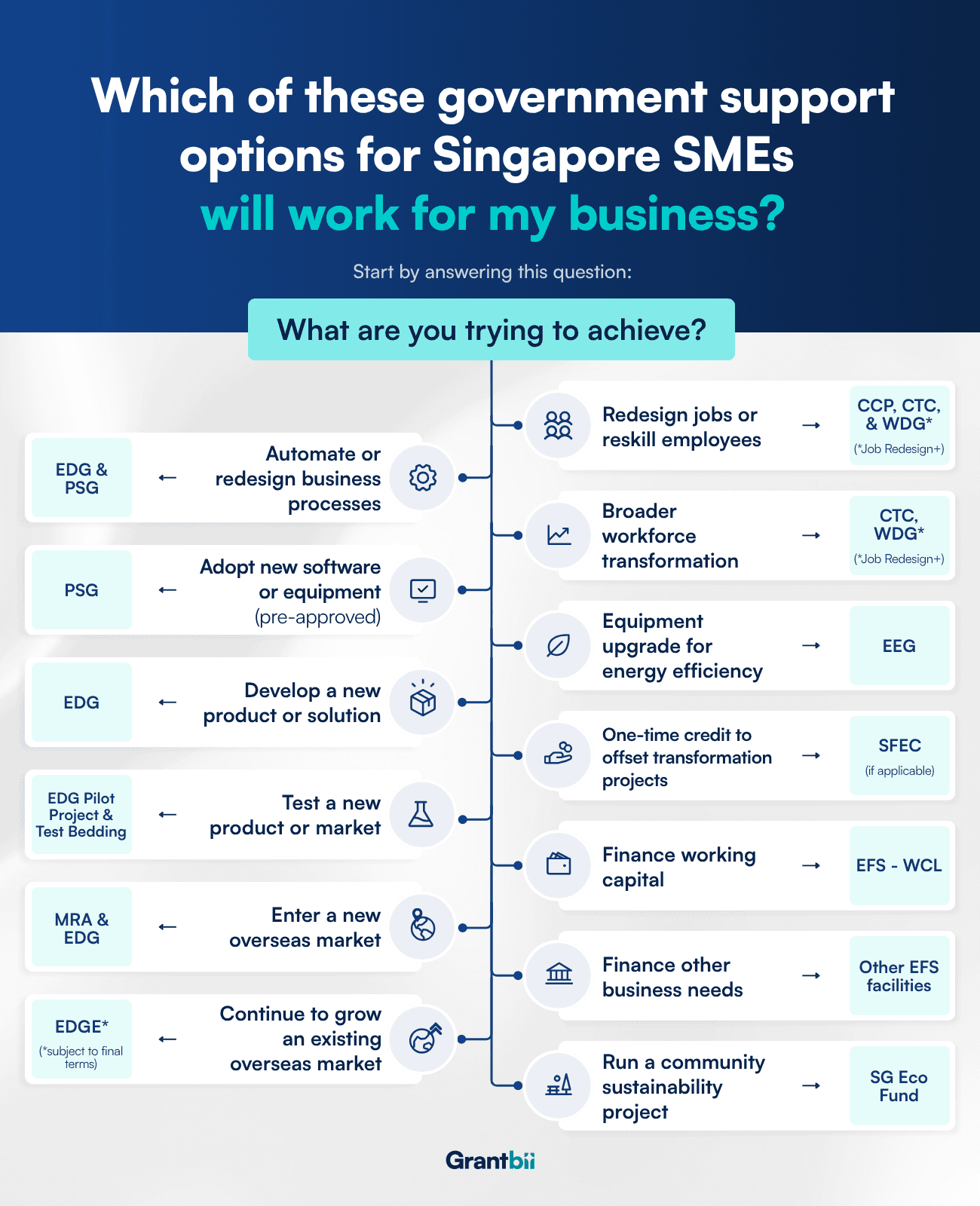
There is no single “best” Singapore SME grant. A higher support percentage does not necessarily make one scheme better than another if the project itself is not a good fit. The right mindset when reviewing grants and other funding schemes is to find the right match for a specific business or project goal.
This is where Grantbii can help. Grantbii brings years of grant advisory experience through Real Inbound Consulting, with a track record of successfully securing grants for over 10 years. Grantbii helps businesses identify suitable funding options, assess eligibility, shape stronger projects, and navigate implementation. Book a Call with Grantbii or start with the Smart Consultation.
How do Singapore SMEs apply for government grants?
Most Enterprise Singapore grants are submitted through the Business Grants Portal (BGP) using CorpPass.
The general sequence is:
Define the business objective and proposed project.
Identify the relevant grant or financing scheme.
Check company and project eligibility.
Confirm which costs are supportable.
Prepare the project proposal, quotations and required supporting documents.
Submit the application before making commitments or starting the project where the scheme requires prior application.
Wait for approval.
Implement the approved project.
Submit the required claims and supporting documentation.
The process differs for programmes administered by other agencies. For example, EFS applications are made directly through participating financial institutions, while CTC Grant and CCP applications follow their respective NTUC/e2i and WSG processes.
Do Singapore SMEs need to apply for the grant before the project starts?
In many cases, yes.
This is one of the most important mechanics to establish before a company signs a contract, pays a deposit, purchases equipment or begins work.
For example, PSG does not support applications where payment has already been made to the vendor before application, while EEG requires procurement to have not started before application.
A grant should therefore be considered before the commercial commitment, not after an expenditure has already been incurred.
What is changing in Singapore SME grants in 2026?
The most significant change is the introduction of EDGE.
Enterprise Singapore has confirmed that EDGE will consolidate:
Enterprise Development Grant
Productivity Solutions Grant
Market Readiness Assistance
The existing EDG, PSG and MRA schemes remain accessible until EDGE launches.
Enterprise Singapore has also announced that the new framework will broaden overseas support, including support for companies seeking to deepen activities in existing overseas markets rather than being restricted to entering new markets.
However, the detailed EDGE support rates, funding caps and application mechanics have not yet been published. Those figures should therefore not be inferred from the current EDG, PSG or MRA rules.
Some EDGE terms have already been announced as part of the Business Refresh Package, including support of up to S$100,000 per year for eligible activities and the removal of the new-market requirement for overseas expansion support. However, the full terms, including detailed support rates, qualifying costs and application mechanics, have not yet been announced, and what has been announced may still change when EDGE officially launches.
Other 2026 changes are separate from EDGE. These include:
enhanced MRA support of up to 70% for SMEs from 1 April 2026
the new WDG (Job Redesign+)
the current SFEC expiry and subsequent redesign
the announced expansion of EEG to all sectors
enhanced EFS-WCL risk-sharing from September 2026 to March 2027
For businesses planning a project during the transition, the practical issue is timing. A project that already fits an existing scheme should not automatically be delayed simply because EDGE has been announced. At the same time, projects that are still being scoped should be checked against the latest Enterprise Singapore announcements before commitments are made.
Turning Singapore SME grants into a longer-term growth strategy
Taken individually, each scheme addresses a specific business need: adopting technology, redesigning a job, entering a market, improving energy efficiency or funding working capital.
Taken together, they can form part of a longer-term transformation plan:
A business that adopts a digital solution may generate the operational data needed for a subsequent process-redesign project.
A company that tests a product in a new market can use the results to inform a larger expansion decision.
A workforce transformation project can create the internal capability needed to implement new technology rather than simply purchase it.
The objective is to make sure that each funded project contributes to a stronger business capability, better operating model or clearer growth path. That is where grant funding becomes more than short-term cost relief. It can become a strategic lever for transformation and growth.
A comprehensive, intentional, and well-planned transformation agenda is key to helping businesses today grow and adapt. For Singapore SMEs, making the most of readily-available resources such as grants can help move their business to its next stage, as it has for many businesses before them.
Creating growth and transformation plans for high-growth businesses is at the heart of Grantbii’s expertise. Book a call today to learn how we can do that for you.
How Grantbii helps Singapore SMEs with grant and financing strategy
Knowing that a grant exists is only the beginning.
The real work is understanding the project, matching it to the right funding opportunity, preparing a strong application, and managing the requirements through to final disbursement.
Unlike other firms that only help you write and submit your grant application, Grantbii supports Singapore SMEs across the full grant journey.
Grant Discovery and Matching
We recommend suitable grants and financing schemes for your company’s planned project.
Grant Roadmapping
Grantbii helps you plan future grants beyond the first.
We share our expertise with you by walking you through Singapore’s funding architecture and the grants that have helped our clients the most.
We can help you create long-term project planning aligned to the company's growth stage and longer-term business plans.
Project Scoping and Application Preparation
Grantbii can advise you on the critical components for grant application success. We support you by:
Highlighting where the project meets grant requirements
Building the proposal and costing
Preparing forecasts and supporting documents
Navigating the application process from preparation to submission with best practices
Evaluation and Approval
Grantbii supports you even beyond the application submission. We help you:
Respond to evaluator enquiries
Manage requested revisions
Review the offer letter to highlight key terms, deliverables, and requirements before acceptance so you are informed and ready when begin the project
Project Execution
Grantbii helps check that project execution remains aligned with the approved timeline and deliverables. We offer:
Support for documentation requirements, including receipts, invoices and bank statements
Assistance for project amendment requests such as timeline extensions, scope changes and partial disbursements
Claims and Final Disbursement
Grantbii continues through the final evaluation and disbursement process until the client receives the final claims. We can help to:
Check vendor invoices and supporting records
Consolidate paperwork
Prepare final reports
Engage the claims auditor
Support responses to audit enquiries
At Grantbii, we have a strategic and experience-informed process that carries the project from opportunity discovery to final grant disbursement.
Get the conversation started today. Book a Call or try our Smart Consultation tool.
Conclusion: Which Singapore SME grants and support schemes should businesses explore in 2026?
The best Singapore SME grants and financing options depend on the business objective, the type of project being undertaken and the timing of the investment.
EDG is relevant for broader transformation, automation, product development and market-access projects.
PSG is suited to pre-approved productivity solutions.
MRA supports overseas expansion, while EEG addresses eligible energy-efficiency investments.
CTC, CCP and WDG (Job Redesign+) address different aspects of workforce and business transformation.
SFEC provides additional support for eligible employers with remaining credit.
EFS provides repayable financing for working capital and other business needs.
SG Eco Fund is relevant to community-based environmental sustainability projects.
The funding landscape is also changing in 2026. EDGE will consolidate EDG, PSG and MRA, while other schemes have been enhanced or introduced separately. Businesses should therefore check the latest official terms before applying, particularly where a scheme is approaching a transition or its support rate, cap or eligibility rules have recently changed.
For businesses researching Singapore SME grants, the most useful starting point is not simply the grant with the highest percentage. It is the scheme that best matches the project, its eligible costs, the company's funding capacity and the business outcome it is intended to create.