The Founder's Guide to the Singapore Budget 2026: Grants, Tax Deductions, and AI Support

The Singapore Budget is presented to Parliament every February, setting out the SG government's spending and tax policy for the year ahead. For business owners, the relevant parts usually fall into two categories: costs going up (like requirements for employers) and support becoming available (like grants and tax deductions).
Budget 2026 was delivered on 12 February 2026 by Prime Minister Lawrence Wong, who also serves as Minister for Finance. For founders and growth-stage companies, it is notable for its emphasis on internationalisation and AI adoption.
Some of the most important points of Singapore’s 2026 Budget include:
several grant schemes enhancements
the cap on a key tax deduction for overseas expansion was more than doubled
a new tax incentive for AI deployment was introduced
This article focuses on the changes most relevant to SMEs and scale-ups planning overseas expansion or technology investment, and what to do about them now.
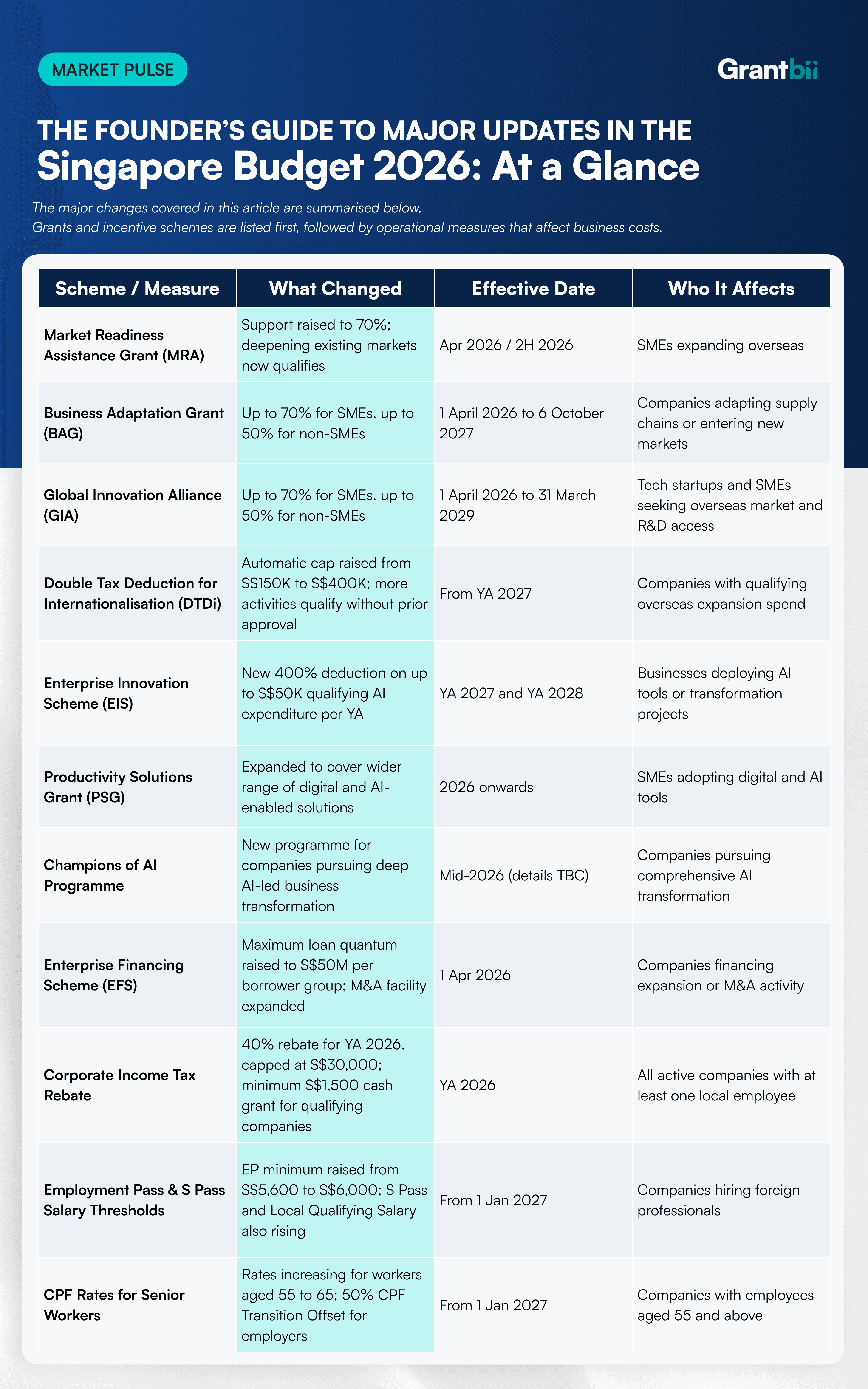
Singapore Budget 2026: At a Glance
The major changes covered in this article are summarised below. Grants and incentive schemes are listed first, followed by operational measures that affect business costs.
Grants and Tax Incentives
The following sections cover the grant schemes and tax incentives enhanced under Budget 2026, and what each means for your company's planning.
1. MRA Grant Singapore 2026: Higher Support Levels and Broader Eligibility
What is the Market Readiness Assistance (MRA) grant?
MRA is administered by Enterprise Singapore, helps Singapore companies defray the costs of overseas market entry. Two significant enhancements arrived under Budget 2026: increased internationalisation support and expanded market eligibility.
Increased Internationalisation Support
From 1 April 2026, support levels for MRA and related internationalisation schemes will increase to up to 70% of eligible costs for SMEs. This reinstates the level that was reduced to 50% in 2023, with the S$100,000 grant cap extended until 31 March 2029.
Expanded Market Eligibility
From the second half of 2026, when the new EDGE grant goes into effect, the eligibility for overseas market funding will be expanded to include overseas markets with existing presence.
Companies will no longer need to enter a new market to qualify. Support will include companies that are deepening their presence in markets they already operate in, a shift that reflects where most real growth actually happens for established scale-ups.
Qualifying MRA activities include:
Marketing & PR
Physical & Virtual Trade Fair
Identification of Overseas Partners
In-market Business Development
Market Presence
Market Setup
What to do in 2026
If you are already operating in any overseas markets, you can now leverage MRA to deepen your presence in those markets. Start identifying which markets and activities fall into this category so you are ready to apply when the scheme opens.
Since eligibility has been expanded, you can also revisit market expansion projects that previously didn't qualify. Those projects may now be worth resubmitting, especially where the grant can help de-risk the expansion.
2. Singapore Internationalisation Support Beyond MRA: BAG and GIA Programmes
MRA often dominates the conversation on internationalisation support, but Budget 2026 also strengthens two other schemes that many companies tend to underutilise. From 1 April 2026 to 31 March 2029, support levels will increase to up to 70% of eligible costs for SMEs and up to 50% for non-SMEs.
Business Adaptation Grant (BAG)
What is the Business Adaptation Grant (BAG)?
BAG co-funds the cost of restructuring supply chains and overseas operations when companies need to respond to trade disruptions, tariffs, or shifts in global market conditions.
Support levels were enhanced to up to 70% for SMEs and up to 50% for non-SMEs, effective 1 April 2026 and running until 6 October 2027. The grant cap remains at S$100,000 per enterprise.
For companies actively redesigning sourcing or diversifying exposure to geopolitical or cost risks, this becomes increasingly relevant. Note that BAG support enhancement runs until 6 October 2027.
What to do in 2026
If your plans include expanding into new markets, building overseas partnerships, diversifying supply chains, or running co-innovation projects, review whether BAG or GIA support applies. Most founders default to MRA alone. These programmes can support larger and more strategic expansion moves.
Global Innovation Alliance (GIA) Programmes Support
What are the Global Innovation Alliance (GIA) Programmes?
The Global Innovation Alliance (GIA) is a network of Singapore and overseas partners across more than 50 countries, administered by Enterprise Singapore. It is designed to help Singapore-based tech startups and SMEs access overseas markets and innovation ecosystems through structured programmes.
GIA programmes are structured frameworks that help Singapore-based businesses access overseas markets through facilitated partnerships and networks.
Companies accepted into certain GIA partner programmes can apply for financial support to offset the cost of participation. GIA is not a grant or funding scheme in itself, but Enterprise Singapore offers support for certain aspects of specific programmes under GIA. Support does not apply uniformly across all GIA programmes.
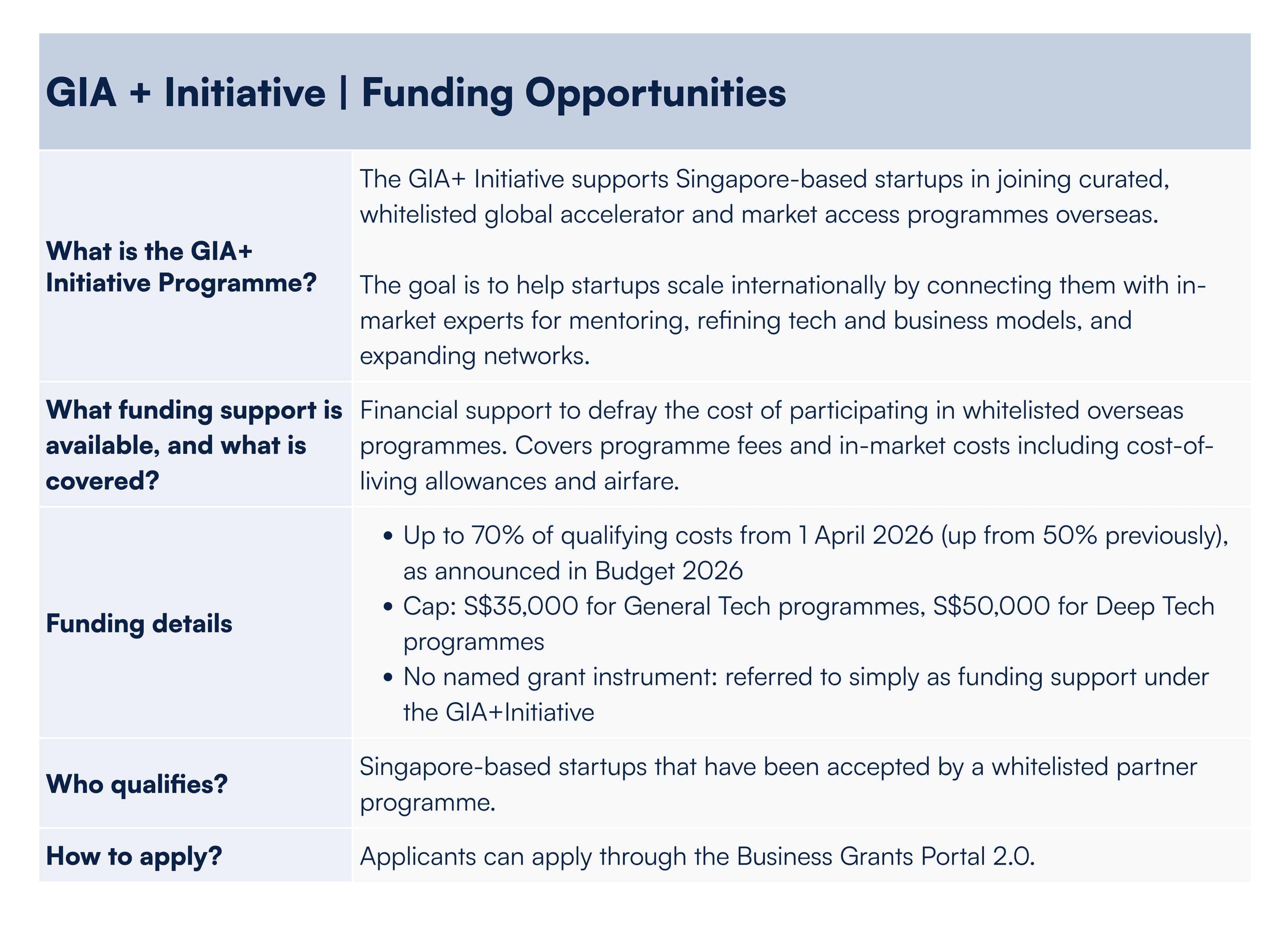
GIA+ Initiative
According to the Singapore 2026 Budget, GIA+ Initiative support changed from 50% to up to 70%, effective 1 April 2026 for GIA+ applications from that date onwards. Caps remain unchanged at S$35,000 for General Tech and S$50,000 for Deep Tech.
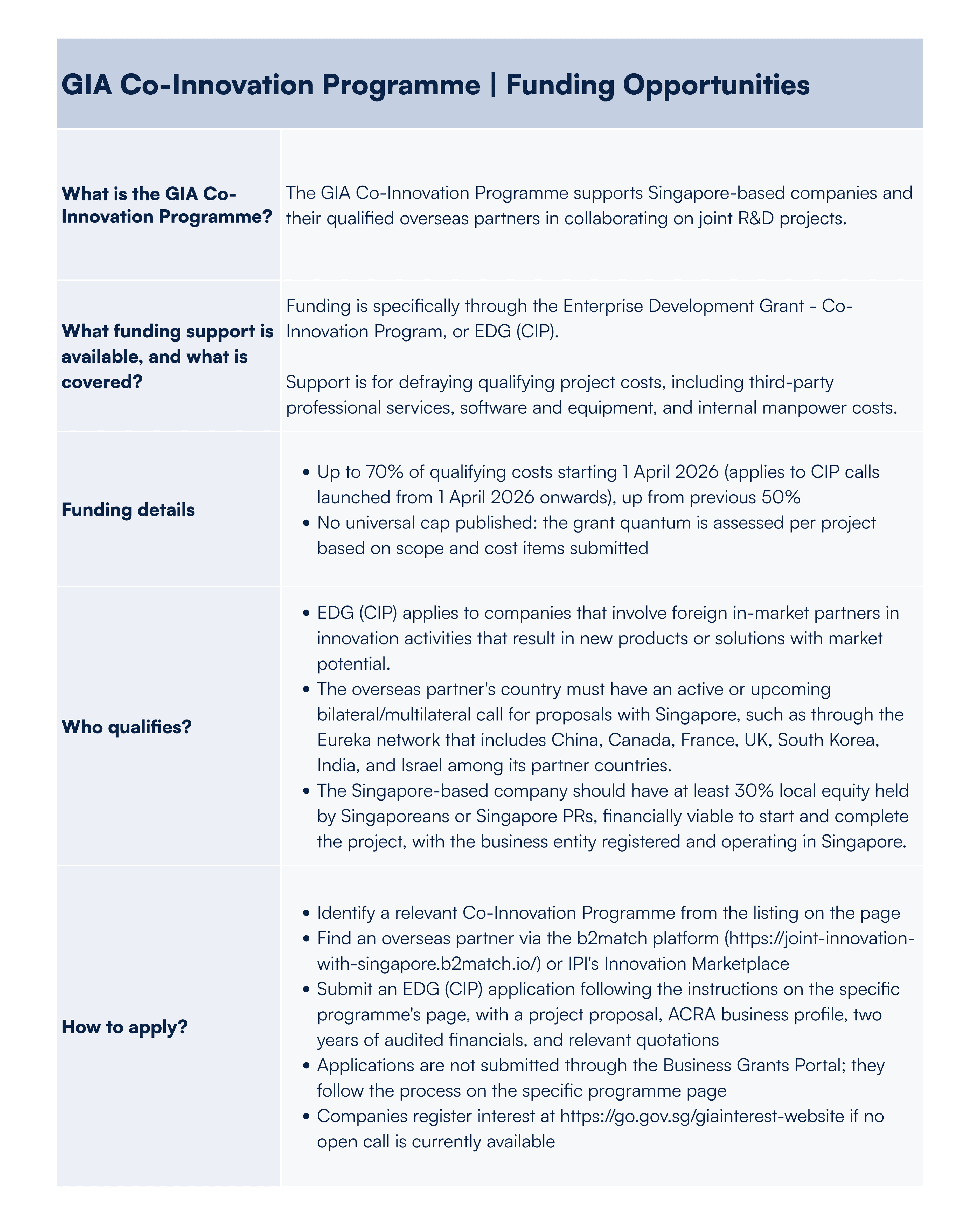
GIA Co-Innovation Programme
According to the Singapore 2026 Budget, GIA Co-Innovation support for SMEs increased from up to 50% of qualifying costs to up to 70%. This is effective for CIP calls launched from 1 April 2026 onwards.
3. DTDi Singapore: A Larger and Easier Tax Deduction for Overseas Expansion
Budget 2026 makes two meaningful improvements to the Double Tax Deduction for Internationalisation (DTDi) scheme: the automatic deduction cap more than doubles from S$150,000 to S$400,000 per Year of Assessment, and the scope of activities that qualify without prior approval is being expanded.
For founders already spending on overseas expansion, this means larger tax deductions on more of what they are already doing, with less administrative friction than before.
What is the Double Tax Deduction for Internationalisation (DTDi)?
The Double Tax Deduction for Internationalisation (DTDi), administered by Enterprise Singapore and the Inland Revenue Authority of Singapore (IRAS), is a tax incentive. It allows companies to claim a 200% tax deduction on qualifying overseas expansion expenses.
For example: if your company spends S$100,000 on qualifying internationalisation activities, you can deduct S$200,000 from your taxable income. On a taxable income of S$1,000,000 before the deduction, that brings your taxable base down to S$800,000.
Change 1: Automatic cap raised from S$150,000 to S$400,000 per YA
The cap applies on a per company and per year of assessment (YA) basis regardless of how many DTDi activities are claimed. Expenses exceeding S$400,000 per YA still require prior approval from Enterprise Singapore before the activity commences.
Change 2: No prior approval requirements for three specific trip expenses
Previously, even within the automatic activities of overseas market development trips and investment study trips, the following specific expenses required prior approval from Enterprise Singapore:
Fees to secure speaking spots at overseas business or trade conferences
Logistics costs for transporting materials and samples during missions
Third-party consultancy costs to arrange business networking events
From YA 2027, these three are now automatic and no longer need prior approval before being incurred.
Change 3: Scope of activities for automatic claims expanded
Budget 2026 announced that the scope of activities eligible for automatic claims would be expanded to cover a wider range. The activities that have historically qualified for DTDi include:
Overseas market development trips and missions
Overseas investment study trips and missions
Overseas trade fairs
Local trade fairs approved by Enterprise Singapore or the Singapore Tourism Board
Virtual trade fairs approved by Enterprise Singapore
Product and service certification approved by Enterprise Singapore
Overseas advertising and promotional campaigns
Design of packaging for overseas markets
Advertising in local trade publications approved by Enterprise Singapore
The activities that have been confirmed as newly added to the automatic claims list, with effect from YA 2027, are:
Investment feasibility and due diligence studies
Master licensing and franchising
Market surveys and feasibility studies
Overseas business development
Production of corporate brochures for overseas distribution
The following were not added to the automatic claims list, and remain under prior approval:
e-Commerce campaigns
Overseas trade offices
Important Note:
One important point if you are using other grants and DTDi: the grant and the tax deduction do not stack on the same dollar.
DTDi is claimed on the net cost after any grant received. If, for example, MRA covers 70% of an activity, only the remaining 30% out of pocket is eligible for the DTDi deduction. Both schemes can still be used together on the same project, but on different portions of the cost.
Speak with your tax advisor about structuring your expansion spend to account for this and maximise your combined benefit across both schemes.
4. Singapore AI Grants and the Enterprise Innovation Scheme: Support for Real Deployment
Companies can claim enhanced tax deductions or an optional cash payout on qualifying expenditures under the Enterprise Innovation Scheme (EIS), which helps companies offset the cost of innovation activities, including R&D, intellectual property registration, and technology adoption.
Under Budget 2026, AI Expenditure was added as a 6th qualifying activity, in addition to the existing five that did not cover AI adaptations costs, which were: R&D conducted in Singapore, IP registration, IP acquisition or licensing, eligible SkillsFuture training courses, and innovation projects with qualified partner institutions.
This change will allow businesses to claim 400% tax deductions or allowances on up to S$50,000 of qualifying AI spend per Year of Assessment, for YA 2027 and YA 2028. Note that the option to convert qualifying AI expenditure into a non-taxable cash payout is not available for this category.
The signal from the government is clear: support is shifting away from AI experimentation and toward real deployment and business transformation, particularly in sectors such as manufacturing, healthcare, finance, and connectivity.
What to do in 2026
If AI is still in the proof-of-concept stage at your company, now is the time to move toward structured deployment. Identify where AI genuinely improves margin, productivity, or product differentiation.
Consult with experts like Grantbii to ensure your transformation projects are documented in a way that can support EIS claims. The incentive rewards deployment and measurable business outcomes, not experimentation.
5. Productivity Solutions Grant: Expanded Digital and AI Coverage
The Productivity Solutions Grant (PSG) co-funds the adoption of pre-approved digital solutions and equipment. It is one of the most accessible digitalisation grants for Singapore SMEs, typically covering up to 50% of qualifying costs, with support of up to S$30,000.
Under Budget 2026, the PSG has been expanded to cover a wider range of digital and AI-enabled solutions. This makes it a practical complement to the EIS AI deduction: the PSG reduces the upfront cost of adopting AI tools, while the EIS provides a tax deduction on qualifying AI expenditure.
As of this writing, there is no confirmed update yet if any of these terms will change after EDGE launches. EDGE will streamline PSG, EDG, and MRA into a single scheme.
What to do in 2026
If it's your company's first time evaluating AI or digital tools, check out PSG's pre-approved solutions list.
6. Champions of AI Programme: Deeper Business Transformation Support
Budget 2026 introduces a new Champions of AI programme designed for companies that want to use AI to transform their businesses more comprehensively. This programme provides customised support including workforce training and enterprise transformation assistance.
The programme is aimed at companies ready to move beyond isolated AI tools and toward organisation-wide adoption. Full details, including eligibility criteria and support levels, are expected to be released in mid-2026.
The latest update indicates that the programme will pilot with a few shortlisted companies first.
7. Enterprise Financing Scheme: Higher Loan Limits for Expansion
The Enterprise Financing Scheme (EFS), administered by Enterprise Singapore, provides government-backed financing across several facilities including trade loans, fixed asset loans, venture debt, and green financing. It is designed to help Singapore companies access credit for growth activities where commercial financing alone may be insufficient.
Under Budget 2026, the maximum loan quantum across EFS facilities has been increased to S$50 million per borrower group, up from the previous limit. This provides significantly more headroom for companies with larger financing needs, particularly for overseas activities. The EFS Merger and Acquisition facility has also been expanded to support financing for both domestic and overseas M&A activities.
What to do in 2026
If your expansion or acquisition plans have previously been constrained by EFS loan limits, the higher quantum from 1 April 2026 may open up financing options that were not available before. Review your financing structure with your bank or financial advisor in light of the updated limits.
2026 Budget Changes That Apply to Every Business
Beyond grants and incentive schemes, Budget 2026 includes several measures that will affect business costs and workforce planning directly. These are not optional considerations: they will flow through to payroll, hiring budgets, and tax filings on a fixed timeline.
8. Corporate Income Tax Rebate for YA 2026
For the Year of Assessment 2026, all active companies will receive a 40% Corporate Income Tax (CIT) rebate, capped at S$30,000. Every active company that employed at least one local employee in 2025 will qualify for a minimum benefit of S$1,500 in the form of a CIT rebate cash grant, even if the company is not profitable. The total benefit per company is capped at S$30,000.
This is a continuation of CIT rebates offered in previous years, though at a slightly reduced level: the YA 2025 rebate was 50% capped at S$40,000. The reduction reflects a gradual unwinding of post-pandemic business support as the economy normalises.
What to do in 2026
The CIT rebate, will be automatically applied when filing your YA 2026 corporate tax return, so no action is required on your part.
Factor the benefit into your 2026 cash flow projections. Loss-making companies with local employees should note the S$1,500 minimum cash grant.
9. Work Pass Salary Threshold Increases
From 1 January 2027, the minimum qualifying salary for new Employment Pass (EP) applicants will rise from S$5,600 to S$6,000 per month (S$6,600 for positions in the financial services sector). S Pass minimum salaries and the Local Qualifying Salary (the minimum a company must pay all local workers before it can hire foreign workers on certain passes) will also increase.
These changes affect the cost of hiring foreign professionals and the compliance threshold for companies that rely on a mix of local and foreign staff. Companies that are planning to hire foreign talent in 2026 should assess whether any current or planned roles fall near the new thresholds.
What to do in 2026
Review your headcount plan against the new EP and S Pass thresholds before January 2027. If you have roles currently filled at salaries close to the new minimums, factor in the adjustment in your FY2027 payroll budget. Roles in the financial services sector face a higher threshold and should be reviewed separately.
10. CPF Rate Increases for Senior Workers
From 1 January 2027, CPF contribution rates for senior workers will increase. Rates for workers aged above 55 to 60 will rise to 35.5%, and for workers aged above 60 to 65, to 26%. These increases apply to both the employee and employer contributions.
To soften the immediate impact on employers, a one-year CPF Transition Offset will automatically cover 50% of the employer-side increase. However, businesses with a significant number of employees in these age bands should model the net cost impact into their FY2027 staffing budgets now, as the offset only partially cushions the increase and applies for one year only.
What to do in 2026
Identify how many of your current employees fall in the 55 to 65 age range. Model the increase in employer CPF contributions from January 2027, net of the Transition Offset, into your HR budget for FY2027. If you are planning to hire in this age group, factor the higher rates into your total employment cost calculations.
Frequently Asked Questions on Singapore Budget 2026 Grants
Q: What is the MRA grant in Singapore?
The Market Readiness Assistance (MRA) grant is administered by Enterprise Singapore and co-funds qualifying overseas expansion activities for Singapore-registered SMEs. Eligible activities include overseas business development, market entry consultants, and overseas marketing efforts. From April 2026, support increases to up to 70% of eligible costs, capped at S$100,000 per company per market.
Q: What does DTDi cover in Singapore?
The Double Tax Deduction for Internationalisation (DTDi) allows companies to claim a 200% tax deduction on qualifying overseas expansion expenses, such as trade fairs, overseas BD trips, market surveys, and promotional campaigns. From YA 2027, the automatic deduction cap rises from S$150,000 to S$400,000 per Year of Assessment, and more activities qualify without prior approval.
Q: How does the Enterprise Innovation Scheme work?
The Enterprise Innovation Scheme (EIS) provides enhanced tax deductions on qualifying innovation expenditures, including R&D, IP registration, and technology adoption. Under Budget 2026, a new AI-specific category is introduced for YA 2027 and YA 2028, offering 400% deductions on up to S$50,000 of qualifying AI expenditure per Year of Assessment.
Q: Who qualifies for the MRA grant in Singapore?
Singapore-registered SMEs with at least 30% local shareholding and annual sales turnover of no more than S$100 million, or employment of no more than 200 workers, are generally eligible. Specific eligibility criteria are set by Enterprise Singapore and may vary by activity. Check Enterprise Singapore's website or speak with a grant consultant for your specific situation.
Q: Does the corporate income tax rebate apply to all companies?
The 40% CIT rebate for YA 2026 applies to all active companies and is capped at S$30,000. Companies that are not profitable but employ at least one local employee with CPF contributions in 2025 will receive a minimum cash grant of S$1,500. No application is required: the rebate is applied automatically at the point of tax filing.
Q: Which of these Budget 2026 changes need my immediate attention?
The answer depends on what your company is planning, but three changes have time-sensitive windows that reward early action.
If you are planning overseas expansion: The MRA support level increase to 70% took effect on 1 April 2026. If you have expansion activities in the pipeline, you can access the higher support level rather than the previous 50%. If you have previously shelved expansion projects because they involved deepening an existing market rather than entering a new one, the 2H 2026 eligibility expansion is worth revisiting those plans now.
If you are spending on overseas activities and filing corporate tax: The DTDi cap increase to S$400,000 and the five newly automatic activities take effect from YA 2027. This means expenses incurred from the current financial year onwards may qualify under the new rules. Start tracking and structuring qualifying expenses now, and ensure you are not claiming DTDi on the gross cost of any activity that is also funded by a government grant, since only the net unfunded portion qualifies.
If you are investing in AI tools or transformation projects: The EIS AI deduction of 400% on up to S$50,000 of qualifying AI expenditure is available for YA 2027 and YA 2028 only. It does not extend beyond that under current legislation. Companies that want to maximise this window should identify and scope qualifying AI projects now, ensure they are properly documented, and monitor IRAS for the detailed guidance on what qualifies as AI expenditure.
Q: What kind of companies should act immediately?
Three profiles stand out as having the most to gain from acting before the end of 2026:
Companies already spending on qualifying internationalisation activities. If your company is actively attending trade fairs, running overseas BD trips, conducting market surveys, or producing materials for overseas markets, the DTDi changes from YA 2027 mean more of that spend qualifies automatically and at a higher cap. The action required is not a new project but proper tracking and documentation of what you are already doing, and a conversation with your tax advisor about structuring that spend correctly, particularly if any of those activities are also grant-funded.
Companies that have started using AI tools but have not formalised the investment. The EIS AI deduction covers YA 2027 and YA 2028 only. Companies that are already deploying AI in some capacity but have not scoped or documented those projects in a way that supports a tax claim are leaving money on the table. The window is short and the detailed IRAS guidance on what qualifies as AI expenditure is still being finalised, which means getting ahead of that now rather than waiting gives companies more time to structure qualifying projects properly.
Companies that do not need to act immediately but should plan ahead: any company with employees aged 55 to 65 or with roles filled by foreign professionals near the current EP or S Pass salary thresholds. The changes take effect 1 January 2027, which is not urgent today but will affect FY2027 payroll budgets materially if not modelled in advance.
Singapore Budget 2026: What SMEs Should Do
Budget announcements do not grow companies; decisions do.
The Singapore Budget 2026 grants, tax incentives, and operational changes covered here represent real inputs to how founders should plan the next 12 to 24 months.
On the opportunity side, internationalisation support has been broadened and made more generous, AI deployment is now directly incentivised, and financing limits have been raised. On the cost side, work pass thresholds and CPF rates for senior workers are going up on a fixed timeline, regardless of whether you plan for them.
The founders who benefit most will be those who decide which grants to pursue before committing to expansion budgets, which AI tools to deploy before year-end, and which hires to time around the January 2027 work pass changes.
If your expansion or technology roadmap is already in motion, now is the time to check whether the updated MRA, DTDi, EIS, GIA, and EFS rules change how you structure your next move. And if workforce costs are a material line in your budget, model the 2027 changes before they arrive.
If you want to quickly see which Singapore Budget 2026 grants may be suitable for your expansion or innovation plans, you can use Grantbii's Smart Consultation tool or book a call directly to speak with a grant consultant.